Abstract
The Reproductive Competition Theory of Democracy views competition among groups in democracy as intergenerational competition in which the future electorate changes through births, upbringing, adulthood and civic status, political socialization, participation, migration, naturalization, joining, assimilation, and exit, not merely persuasion of existing voters. “Reproduction” is operationally defined broadly as political demographic reproduction encompassing population, culture, and civic participation.
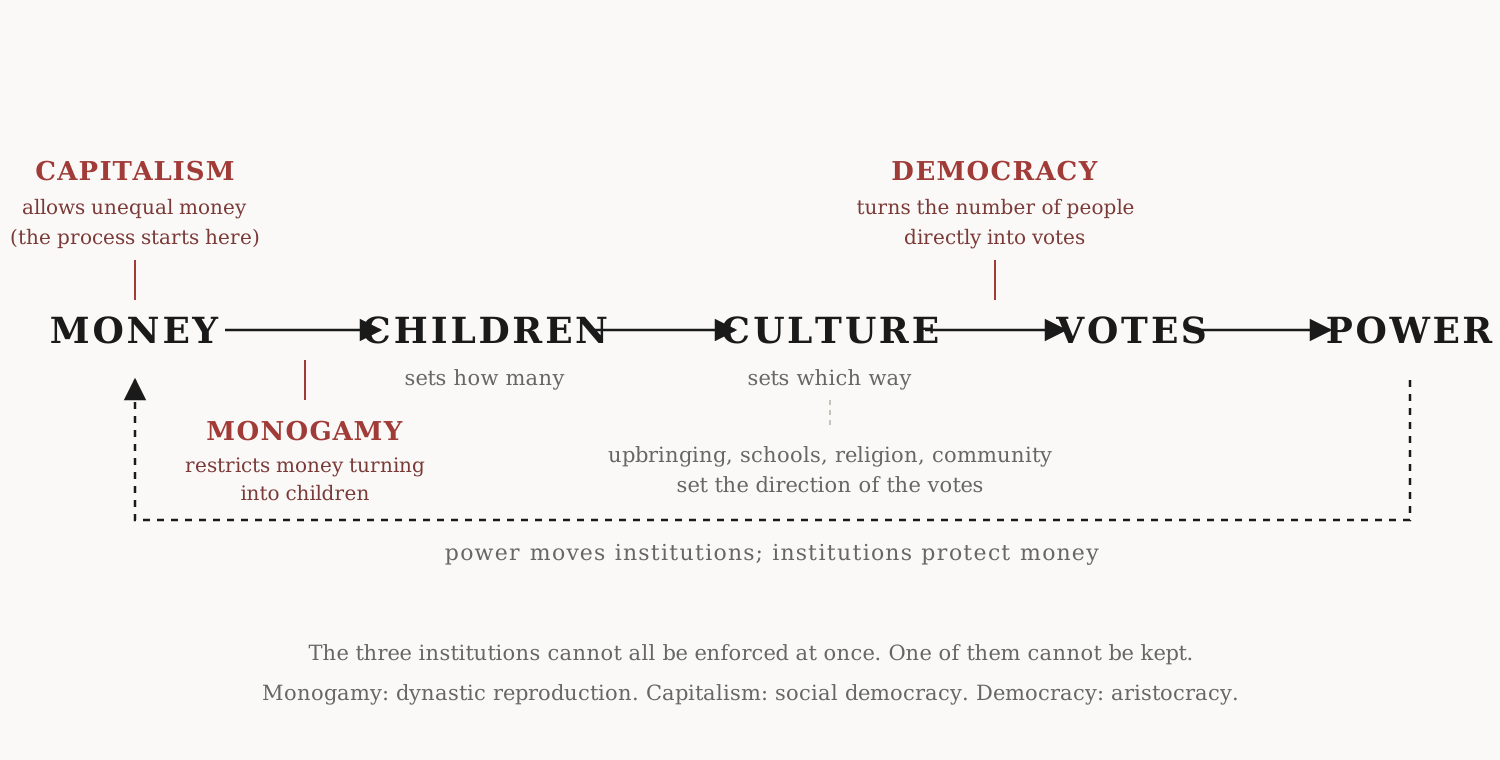
The trilemma links this demographic pathway to institutional analysis. Capitalism concentrates and makes wealth inheritable; democracy converts numbers into political power through one person, one vote; and effective monogamy compresses the conversion of wealth into the scale of one parent’s descendants. When the policy interests of a wealthy minority and a demographic majority conflict, votes actually affect policy, and wealth and political tendencies persist across generations, simultaneously maximizing the pure principles of all three institutions widens the “dominance gap between economic power and voting power.” Society adjusts through redistribution and family support, elite non-majoritarian institutions, tolerance of reproductive concentration, or indirect routes such as migration, party realignment, and social mobility.
The revised edition separates population effects, competitive adaptation, and intentional strategy; separates population, votes, seats, and capital-based influence mathematically; recasts the trilemma as an institutional-pressure model with conditions, alternatives, and falsifiers; and integrates the two theories as the relation between demographic pathways and institutional conditions.
| Category |
|---|
Main contributions of this paper
- Expand the unit of democratic competition from current votes to the future composition of the electorate.
- Treat births, political socialization, participation, migration, joining, and exit as one reproductive process.
- Connect wealth, reproduction, voters, votes, policy, and inheritance in one intergenerational cycle.
- Formulate the relationship among the three institutions as conditional institutional pressure and a problem of complementary institutions, not logical impossibility.
- Specify the conditions under which the theory holds and observations that would weaken it.

The Reproductive Competition Theory explains demographic pathways; the trilemma explains institutional conditions and directions of adjustment.
1. Starting point: electoral competition and voter reproduction
Conventional democratic theory takes the preferences of already existing voters as given and starts with parties and candidates competing for those votes. Over the long term, however, the number, attributes, residence, participation, and group affiliations of voters themselves change. Democracy therefore contains two competitions at once.
| Competition | Content | Main indicators |
|---|---|---|
| Category | Content | Main indicators |
| Category | Content | Main indicators |
Core question
Typical means
Electoral competition
| Who obtains votes from current voters? |
|---|
Policy, speeches, advertising, organization, candidates, coalitions
| Voter-reproduction competition | Content | Main indicators |
|---|---|---|
| Category | Content | Main indicators |
| Category | Content | Main indicators |
| Category | Content | Main indicators |
Who will become voters in the future, belong to which groups, and vote?
Births and upbringing, socialization, naturalization, joining, education, voting habits, geographic settlement
The core of the theory is to make the latter an object of political analysis alongside the former. It is not a theory only of differences in fertility. Between a child’s birth and becoming an adult citizen with a political tendency who votes and is converted into seats by the electoral system lie multiple stages. If any one stage is weak, demographic differences do not become political power.
| 1.1 Meaning of “reproduction” |
|---|
“Reproduction” here abbreviates political demographic reproduction: the persistence and expansion of political groups into the next generation, not a concept that explains individuals through biology alone. The subject includes births, adoption, migration, naturalization, conversion, joining, household socialization, schooling, participation, candidate supply, and organizational succession.
| Important limitation: Children are not property of parents, lineages, religions, parties, or states. Parent–child political association is probabilistic and can be severed by opposition, exit, intergroup marriage, class mobility, and party realignment. The theory addresses statistical and institutional tendencies at group level, not the votes of individual children. | Content | Main indicators |
|---|---|---|
| Category | Content | Main indicators |
| Category | Content | Main indicators |
| Category | Content | Main indicators |
| Category | Content | Main indicators |
1.2 Separating levels of claims

Proposition
Role in this theory
| Weak form: population effect |
|---|
| Differences in births, migration, exit, and participation among groups can change the future composition of the electorate. |
|---|
| Foundation of the theory; assumes no intentional strategy. |
|---|
| Intermediate form: competitive adaptation |
|---|
Groups, parties, and states anticipate demographic change and adjust family policy, naturalization, education, organization, and candidate selection.
- Core of the theory; institutions and strategy are endogenous.
- Strong form: intentional reproductive strategy
- Wealthy lineages or communities intentionally form many political successors to obtain future votes.
- Special upper-bound case; not required for the theory as a whole.
- This distinction removes the overly strong assumption that wealthy people always intend mass reproduction while allowing independent tests of the weaker demographic effect and the intermediate adaptive response.
- 2. The Reproductive Competition Theory of Democracy
2.1 Formal definition
| The Reproductive Competition Theory of Democracy is a conditional institutional hypothesis: political groups compete not only in the short term for existing voters’ support, but also in the long term to change the future electorate through births, adulthood and civic status, political socialization, participation, migration and naturalization, joining and exit, and geographic distribution. | Content |
|---|---|
| Category | Content |
| Category | Content |
| Category | Content |
| Category | Content |
| Category | Content |
| Category | Content |
2.2 Four reproductive pathways
3.1 Operational Definitions of the Three Institutions
| Institution | Operational definition in this paper | Main indicators of the pure principle |
|---|---|---|
| Capitalism C | An institution that recognizes private property, capital accumulation, inheritance, and market access, allowing wealth to be broadly converted into education, housing, healthcare, reproduction, and organization. | Asset concentration, persistence of inheritance, income elasticity, disparities in access to education, childcare, and reproductive technologies |
| Democracy D | An institution in which adult citizens are counted, in principle, one person one vote, and their majority is substantively reflected in policy. | Suffrage, turnout, policy responsiveness, electoral districts, distortions from money and media |
| Effective monogamy M | An institution that compresses reproductive concentration so that even the wealthy cannot greatly expand the biological and social scale of their descendants as a single parent. | Concurrent polygyny, serial remarriage, nonmarital births, assisted reproduction, surrogacy, parentage recognition, co-parenting |
Monogamy cannot be measured by the number of marriage registrations alone. Legally, a person may have only one spouse yet expand reproductive scale through serial remarriage, nonmarital births, gamete donation, surrogacy, or multiple-parent systems. Conversely, even where plural marriage is legal, economic, cultural, and legal constraints may keep actual reproductive inequality small. This paper therefore examines the effective "marginal conversion rate from wealth to descendant scale."
3.2 Conditions for the Conditional Trilemma
The trilemma does not arise merely because the three institutions coexist. When the following conditions overlap, a "dominance gap" emerges between economic power and political power based on numbers.
- Wealth is highly concentrated and persists across generations through inheritance, education, and corporate control.
- The policy interests of a wealthy minority and a population majority conflict over taxation, inheritance, labor, regulation, and related issues.
- The wealthy minority seeks to preserve capital order or policy advantage over the long term.
- Votes are substantively reflected in policy, limiting direct conversion from wealth into policy to some extent.
- Wealth can affect reproductive numbers, children’s human capital, socialization, and organizational succession.
- Political tendencies or recognition of class interests persist across generations, albeit imperfectly.
- The analytical period spans multiple generations rather than a single election.
| Central conversion constraint: substantive democracy limits the conversion "wealth → direct political domination," while effective monogamy limits the conversion "wealth → many descendants → future votes." If capitalism preserves wealth concentration while class interests conflict, the economic power of the wealthy minority separates from the voting power of the population majority. This is the core of the trilemma. |
|---|

Top = capitalism, left = democracy, right = monogamy. The three sides indicate conditional adjustment directions.
4. Three Conditional Adjustment Pathways
4.1 Capitalism + Democracy: Reproductive-Capitalist Democracy
When capitalism is strong, policy decisions through voting are also strong, and effective monogamy is weak, the wealthy, dynasties, and communities can convert capital into many members of the next generation. The political asset here is not merely birth numbers, but next-generation members who become adults and citizens, remain aligned to some extent with a dynasty or community, and vote or participate in organizations.
| Cycle: capital → reproduction, childrearing, and socialization → aligned adult citizens → votes and organization → policy → capital |
|---|
This pathway strengthens when wealth increases the number of children or their human capital, political transmission rates are high, long-term orientation exists, and geographic concentration is reflected in elections. In societies where direct donations and lobbying can move politics sufficiently, the population pathway becomes unnecessary. Thus the proposition is not that "capitalism + democracy necessarily means the wealthy reproduce on a massive scale."
| Ideal-type outcome: wealthy dynasties or organizations convert capital not only into current political influence but also into a future base of aligned voters. It is more likely to appear first in local politics, candidate selection, religious communities, political dynasties, and long-term seat bases than as domination of national elections. |
|---|
4.2 Democracy + Monogamy: Family-Support Social Democracy
To substantively maintain one-person-one-vote and broadly distributed opportunities for one-to-one family formation, lower- and middle-income people must also be able to choose marriage, childbirth, and childrearing. If housing, education, childcare, healthcare, and unemployment risk are left to markets alone, and family-formation capacity is extremely allocated by capital, then even legally monogamous systems allow only the wealthy to form stable families.
When the majority recognizes this inequality as a political issue, it demands socialization of family-formation costs through child allowances, public education, public healthcare, childcare, parental leave, housing support, social insurance, progressive taxation, and similar measures. This is not abolition of capitalism, but a pathway that modifies laissez-faire capitalism toward equal opportunity for family formation.
| Limitation: social democracy is not the only outcome. Conservative familism, corporate welfare, mutual aid in religious communities, and technology-driven reductions in childcare costs may be alternative pathways. What matters is not the institutional label, but who bears the market barriers to family formation and how. |
|---|
4.3 Capitalism + Monogamy: Hereditary Capital Oligarchy
When capital accumulation and inheritance are strongly protected while wealthy people’s reproductive expansion is compressed by effective monogamy, the asset-owning class is unlikely to become a numerical majority. When class interests conflict enough that majority rule threatens capital order through taxation, inheritance, labor regulation, or capital regulation, pressure arises to detach the protection of capital from numerical strength.
This pressure may appear not only as property qualifications, restricted suffrage, and hereditary seats, but also as non-majoritarian veto rights for corporations, asset owners, experts, the judiciary, and central banks; dependence on campaign finance; political dynasties; family trusts; and status-endogamous marriage. A more precise modern term than "aristocracy" is "hereditary capital oligarchy" or "asset-dynasty oligarchy."
| Limitation: monogamy alone does not produce aristocracy. Complementary institutions are needed, including inheritance systems that prevent asset fragmentation, intra-dynastic coordination, transmission of human and political networks, and elite veto rights. |
|---|
4.4 Mixed Equilibria and Detour Pathways
| Detour/complementary pathway | Effect on the trilemma |
|---|---|
| Party realignment and coalitions | Change policies and support coalitions as population composition changes, absorbing the political effects of kinship and birth differences. |
| Immigration, naturalization, and joining | Increase future voters through routes other than birth, shortening political demographic reproduction. |
| High social mobility and intergroup marriage | Descendants depart from parents’ class interests or political tendencies, breaking intergenerational cycles. |
| Campaign-finance regulation and an independent judiciary | Constrain direct conversion from capital to politics while supporting coexistence of the three institutions. |
| Welfare capitalism and conservative family policy | Retain capitalism while partially correcting family-formation costs and political inequality. |
| Technological abundance | Lower the marginal costs of childcare, education, and housing, weakening the link between family-formation opportunity and capital inequality. |
The three types are therefore neither mutually exclusive nor exhaustive. Actual societies lie inside the triangle and make several adjustments at once. The trilemma’s purpose is not to classify countries into three types, but to compare which institutional pressures are strongest and which complementary institutions absorb them.
5. Institutional Dynamics Integrating the Two Theories
The demographic competition theory of democracy explains how future voters are formed, while the three-institution trilemma explains how capital and family institutions open or close that demographic pathway. Integrated, the reproduction of political power can be represented as the following cycle.
| Integrated cycle: capital and institutions → family formation, education, and socialization → aligned adult citizens → votes, seats, and organization → policy and institutions → capital and next-generation conditions |
|---|
Two competitions overlap in this cycle. The first is the "support-acquisition competition" in which parties persuade current voters. The second is the "political reproduction competition" in which groups maintain and expand the numbers, affiliation, and participation of the next generation. If parties change policy to incorporate new population groups, the second competition is absorbed into the first; where group boundaries are strong, demographic differences more readily become long-term differences in political power.
5.1 Position Relative to Existing Research
| Research field | What existing research mainly shows | Connection added by this theory |
|---|---|---|
| Political demography | Population size, composition, migration, and birth affect politics. | Connect demographic change to capital, family institutions, and intergenerational power cycles. |
| Political socialization | Voting participation and political interest have intergenerational persistence, but it is not complete. | Separate birth numbers from transmission and turnout rates, treating them as multiplicative political reproduction. |
| Monogamy and reproductive inequality | Marriage institutions can compress reproductive concentration and competition. | Connect compression of reproductive inequality to democracy’s numerical principle and capital’s conversion capacity. |
| Political economy and elite theory | Even under formal democracy, elites’ de facto power can persist. | Compare direct capital domination and demographic pathways as alternative means of reproducing power. |
| Family policy and fertility research | Employment, housing, childcare, and benefits are complexly related to family formation and fertility. | Position family support as an adjustment mechanism for democracy + monogamy. |
| Inheritance and political-dynasty research | Inheritance systems and dynastic networks can sustain asset and political advantages. | Explain rule by a few dynasties under monogamy in combination with non-majoritarian institutions. |
Existing research does not directly prove this entire theory. For example, Swedish register data show multigenerational persistence of voting participation, and lottery-based wealth-shock studies show that under specific conditions wealth can causally affect men’s marriage and fertility. There is also separate evidence on monogamy and reproductive inequality, elite power under formal democracy, family policy and fertility, and inheritance contracts and dynastic survival among the British aristocracy. This paper’s originality lies in integrating these strands into one intergenerational institutional model.
5.2 Principles for Not Overstating the Theory’s Novelty
- The individual propositions that births affect politics and that parent–child political participation is related are not claimed as new discoveries.
- The novelty lies in an integrated framework connecting the reproduction of population, culture, and civic participation to combinations of capitalism, democracy, and monogamy.
- The strong claim of intentional mass-reproduction domination by wealthy dynasties is an upper-bound theoretical case and requires independent empirical evidence.
- To preserve falsifiability, the theory should not be used as a universal explanation in societies that do not meet its conditions.
6. Falsifiable Hypotheses
6.1 Hypotheses of the Demographic Competition Theory of Democracy
| Hypothesis | Prediction |
|---|---|
| DRC-H1 | Differences in political reproduction rates between groups predict the number of aligned adult citizens in the next generation, even after controlling for current support rates. |
| DRC-H2 | The political effect of birth differences is mediated multiplicatively by adult and citizenship rates, political alignment rates, and turnout. |
| DRC-H3 | Even with the same vote-share difference, the conversion rate into seat differences varies with geographic concentration and the electoral system. |
| DRC-H4 | Intergroup marriage, class mobility, party realignment, and weak political socialization weaken conversion of demographic differences into political-power differences. |
| DRC-H5 | Political effects of demographic reproduction differences are observed earlier in local politics, candidate selection, and within parties than in national politics. |
| DRC-H6 | The greater a party’s policy adaptation, the harder it is to directly predict its long-term vote share from changes in population composition. |
6.2 Trilemma Hypotheses
| Hypothesis | Prediction |
|---|---|
| TRI-H1 | The positive relationship between wealth and descendant scale or investment in children is stronger when effective monogamy is weak and access to reproductive technologies and childcare markets is high. |
| TRI-H2 | The stronger substantive democracy and monogamy are, and the higher market barriers to family formation, the greater political demand for family support and redistribution. |
| TRI-H3 | The stronger capital protection and monogamy are, and the greater the conflict between wealthy and majority interests, the stronger non-majoritarian elite veto rights become. |
| TRI-H4 | The stronger direct capital influence through donations, lobbying, and owned media, the less important long-term domination strategies through population become. |
| TRI-H5 | Equal inheritance and asset division weaken pressure toward hereditary capital oligarchy, while family trusts, primogeniture, and political-dynasty networks strengthen it. |
| TRI-H6 | Even after controlling for institutional conditions, if conversion from wealth to aligned adult voters and political successors is not observed, the intermediate and strong forms are rejected or substantially revised. |
6.3 Observations That Weaken the Overall Theory
- There is little multigenerational persistence in political tendencies, voting participation, or organizational participation.
- Differences in births, migration, and joining do not systematically connect to the number of adult citizens or seat composition.
- Conversion rates from wealth to reproduction, childrearing, and political successors do not vary with marriage or reproductive institutions.
- Even when barriers to family formation are high, the combination of democracy and monogamy does not increase demand for family support.
- Even in societies with strong capital concentration and monogamy, elite veto rights and hereditary networks are not strengthened.
- Party realignment, immigration, and social mobility alone always fully absorb long-term demographic differences.
7. Empirical Research Design
7.1 Units of Analysis and Data
| Unit of analysis | Required data | Purpose |
|---|---|---|
| Individuals and households | Income and wealth, marriage, births and adoption, education, residence, naturalization, voter registration, electoral participation | Measure the pathways from wealth to family formation and political participation. |
| Lineages and kinship networks | Multigenerational wealth, occupations, political donations, candidacy histories, organizational participation | Measure the intergenerational persistence of political and economic advantage. |
| Political groups and communities | Membership size, births, entry and exit, religious retention, organizational activity, geographic concentration | Measure the net political reproduction rate and group boundaries. |
| Electoral districts and municipalities | Demographic composition, turnout, election results, district boundaries, policy expenditure | Measure the conversion of demographic differences into votes, seats, and policy. |
| Countries and institutions | Marriage law, inheritance law, family policy, electoral systems, wealth concentration, democratic responsiveness | Compare institutional interactions within the trilemma. |
7.2 Identification Strategies
- Wealth shocks: Use lottery winnings, inheritances, and asset-price fluctuations to estimate the causal effects of wealth on marriage, fertility, and investment in children.
- Institutional reforms: Treat changes in marriage law, inheritance law, child benefits, childcare, housing policy, and assisted-reproduction regimes as natural experiments.
- Electoral systems: Use redistricting, differences between proportional representation and single-member districts, and municipal boundaries to measure the conversion of demographic differences into disparities in seats.
- Adoption, sibling, and kinship designs: Separate, insofar as possible, genetics from socialization, households from neighborhoods, and parental resources from political culture.
- Agent-based models: Model births, socialization, immigration, inheritance, voting, and party adaptation simultaneously to explore thresholds and necessary conditions.
7.3 Minimum Empirical Program
| Stage | Test | Criterion for success |
|---|---|---|
| 1 | Estimate the interaction among wealth, marriage institutions, and fertility/investment in children. | The effect of wealth varies systematically with institutional conditions. |
| 2 | Track birth cohorts through adulthood, acquisition of citizenship, and political participation. | Each stage of B×ω×τ×q can be estimated separately. |
| 3 | Add geographic concentration and electoral systems, and measure their effects on votes and seats. | Demographic differences are converted into political outcomes under specified conditions. |
| 4 | Compare institutional responses in family support, elite veto power, and reproductive concentration. | The three adjustment pressures differ according to the conditions under which they arise. |
| 5 | Compare the theory with models that include alternative pathways. | Distinct explanatory power remains even after party realignment, immigration, and direct capital influence are included. |
7.4 Measurement Considerations
- Do not over-infer secret ballots at the lineage level. Measure political alignment using multiple indicators, including party registration, donations, candidate support, policy attitudes, and electoral participation.
- Do not double-count births for both women and men. Clearly specify whether the unit is the household, the parent-child relationship, or the cohort.
- Distinguish legal monogamy from effective reproductive concentration. Include nonmarital births, remarriage, assisted reproduction, and social parenthood.
- Examine heterogeneity by stratum, gender, birth order, region, religion, and immigrant generation, rather than relying solely on national averages.
- Because group boundaries themselves change endogenously, do not rely exclusively on fixed ethnic, religious, or class classifications.
8. Major Objections and Theoretical Responses
| Objection | Response |
|---|---|
| The wealthy have fewer children, so wealth is not converted into reproduction. | The relationship between wealth and fertility varies by period, gender, birth order, and institution. The theory does not posit an invariably positive correlation; it argues that effective monogamy, childcare markets, and reproductive technologies condition the conversion rate. |
| Children do not vote in the same way as their parents. | Correct. The political alignment rate is not set to 1; backlash, exit, party realignment, and class mobility are explicitly included. The strong form requires a high transmission rate. |
| A single wealthy person cannot dominate national politics. | The strong form requires multiple generations, multiple lineages, community coordination, and geographic concentration. It should first be tested in local politics and candidate selection. |
| The wealthy can shape politics through donations and lobbying. | Direct capital influence is an alternative to the demographic pathway. Indeed, a society with a large β moves closer to the “capitalism plus monogamy” side, where substantive democracy is weak. |
| The three institutions already coexist. | In practice, taxation, welfare, inheritance law, campaign-finance regulation, the judiciary, upper chambers, and family law qualify their pure principles. The theory does not deny coexistence; it explains the adjustment mechanisms that sustain it. |
| Monogamy is not the same as the number of births. | Accordingly, the relevant measure is not the legal number of spouses, but the effective constraint on converting wealth into one parent's number of descendants. |
| Social democracy, oligarchy, and reproductive democracy are neither inevitable nor exhaustive. | The three types are ideal types for comparison and explicitly allow mixed institutions and circumventions through immigration, party realignment, social mobility, technological progress, and other pathways. |
| The theory risks treating women as instruments of reproduction. | The autonomy and consent of reproductive agents are boundary conditions, and the descriptive account of political efficacy is separated from normative endorsement. Power, burdens, and bodily costs must be analyzed independently by gender. |
8.1 Scope Conditions of the Theory
The theory is most readily applicable to societies in which suffrage is broad, demographic composition is reflected in politics, and groups, lineages, and organizations persist across multiple generations. Its explanatory power diminishes in authoritarian regimes, extremely fluid societies, societies with virtually no political transmission, and societies in which immigration or party realignment overwhelms demographic change.
Moreover, none of the three institutions is one-dimensional. Capitalism combines property rights, inheritance, and marketization; democracy combines suffrage, responsiveness, and distortions caused by money; and monogamy combines marriage rules, reproductive technologies, and legal parentage. Each institution must therefore be measured with multiple indicators.
9. Ethical Boundaries
This theory describes and compares pathways through which power is reproduced across generations; it is not a normative theory recommending any particular reproductive regime. Its application in research and policy must observe the following boundaries.
| Principle | Content |
|---|---|
| Consent | Marriage, reproduction, assisted reproduction, and co-parenting require the free and fully informed consent of all parties. |
| Personhood | Children are neither the property of parents, lineages, parties, religions, or states, nor predetermined votes. |
| Equality | The theory does not justify differences in rights based on gender, ancestry, religion, class, disability, or origin. |
| Non-coercion | It rejects forced reproduction, sterilization, eugenic policies, forced marriage, compelled voting, and collective punishment of immigrant groups. |
| Separation of description from endorsement | Explaining that an institution is effective at maintaining power does not amount to endorsing that institution. |
| Privacy | Research linking lineages, births, and political participation must rigorously employ aggregation, anonymization, purpose limitation, and safeguards against re-identification. |
| Research red line: Operational guidance for increasing or decreasing the birth rate of a specific group, inferences that determine an individual's political orientation from ancestry, and institutional designs that treat children as political assets are not legitimate uses of this theory. |
|---|
10. Conclusion
The long-term subjects of democracy are not only voters who exist today. Future people—who will be born and raised, form values and perceptions of interest, become citizens, and vote—are also outcomes of institutions. The theory of democratic reproductive competition treats the future composition of the electorate as an endogenous variable in political competition.
Capitalism introduces unequal resources into this process, democracy converts numbers into votes, and monogamy compresses the conversion of wealth into numbers of descendants. The three institutions are not logically incompatible. Yet the more strongly intergenerational wealth persistence, conflict between class interests, substantive one-person-one-vote equality, the conversion of wealth into reproduction and child-rearing, and political transmission coincide, the more complementary institutions are required to maintain the pure forms of all three simultaneously.
When such complements are insufficient, adjustment pressures may arise toward family-supportive social democracy that modifies laissez-faire capitalism, hereditary capitalist oligarchy that constrains substantive democracy, or reproductive capitalist democracy that weakens effective monogamy and permits wealth to be converted into future votes. However, alternative pathways such as party realignment, immigration, social mobility, direct capital influence, and technological progress make actual equilibria mixed.
| Final definition of the theory of democratic reproductive competition: A conditional hypothesis in political demography and institutional analysis holding that political groups in a democracy face not only electoral competition for present support, but also long-term competition to alter the future composition of the electorate through the reproduction of populations, cultures, and civic participation. |
|---|
| Final definition of the trilemma: A conditional institutional dynamic in which the concentration and convertibility of wealth, political equality by number, and the compression of reproductive concentration come into tension across generational replacement; under persistent conflict between class interests, strengthening the pure principles of all three institutions increases pressure for complementary institutions or for substantive modification of at least one institution. |
|---|
60-Second Summary
In a democracy, politics concerns not only present votes but also who will become voters in the future. Groups alter their political size in the next generation through births, child-rearing, socialization, naturalization, recruitment, and electoral participation. This is the theory of democratic reproductive competition. Capitalism concentrates wealth and allows it to be invested in the number of children, education, and organization. Democracy, meanwhile, converts numbers into one-person-one-vote representation, while monogamy limits the ability of wealthy people to convert wealth into numerous descendants. When the interests of a wealthy minority conflict with those of the demographic majority, a society adjusts through family support and redistribution, elite constraints on democracy, acceptance of reproductive concentration, or mechanisms such as immigration and party realignment. This is not an inevitable three-way choice, but a theory predicting the conditions under which particular institutional pressures intensify.
200-Character Summary
The theory of democratic reproductive competition views political competition not only as a contest for present votes, but also as competition to reproduce future electorates through fertility, socialization, immigration, and electoral participation. Capitalism concentrates wealth, democracy converts numbers into votes, and monogamy compresses the conversion of wealth into descendants. When class conflict persists, conditional pressures arise toward redistribution, oligarchization, or reproductive concentration.
References
Acemoglu, Daron, and James A. Robinson. 2000. “Why Did the West Extend the Franchise? Democracy, Inequality, and Growth in Historical Perspective.” The Quarterly Journal of Economics 115(4): 1167–1199.
Acemoglu, Daron, and James A. Robinson. 2008. “Persistence of Power, Elites, and Institutions.” American Economic Review 98(1): 267–293. DOI: 10.1257/aer.98.1.267.
Acemoglu, Daron, Suresh Naidu, Pascual Restrepo, and James A. Robinson. 2015. “Democracy, Redistribution, and Inequality.” In Handbook of Income Distribution, Vol. 2B, 1885–1966.
Asako, Yasushi, Takeshi Iida, Tetsuya Matsubayashi, and Michiko Ueda. 2015. “Dynastic Politicians: Theory and Evidence from Japan.” Japanese Journal of Political Science 16(1): 5–32.
Cesarini, David, Erik Lindqvist, Robert Östling, and Anastasia Terskaya. 2023. “Fortunate Families? The Effects of Wealth on Marriage and Fertility.” NBER Working Paper 31039. DOI: 10.3386/w31039.
Fluchtmann, Jonas, Valerie van Veen, and Willem Adema. 2023. “Fertility, Employment and Family Policy: A Cross-Country Panel Analysis.” OECD Social, Employment and Migration Working Papers, No. 299. DOI: 10.1787/326844f0-en.
Gilens, Martin, and Benjamin I. Page. 2014. “Testing Theories of American Politics: Elites, Interest Groups, and Average Citizens.” Perspectives on Politics 12(3): 564–581.
Gobbi, Paula E., and Marc Goñi. 2021. “Childless Aristocrats: Inheritance and the Extensive Margin of Fertility.” The Economic Journal 131(637): 2089–2118. DOI: 10.1093/ej/ueaa126.
Gould, Eric D., Omer Moav, and Avi Simhon. 2008. “The Mystery of Monogamy.” American Economic Review 98(1): 333–357. DOI: 10.1257/aer.98.1.333.
Henrich, Joseph, Robert Boyd, and Peter J. Richerson. 2012. “The Puzzle of Monogamous Marriage.” Philosophical Transactions of the Royal Society B 367: 657–669. DOI: 10.1098/rstb.2011.0290.
Jennings, M. Kent, Laura Stoker, and Jake Bowers. 2009. “Politics across Generations: Family Transmission Reexamined.” The Journal of Politics 71(3): 782–799.
Lindgren, Karl-Oskar, and Sven Oskarsson. 2023. “The Perpetuity of the Past: Transmission of Political Inequality across Multiple Generations.” American Political Science Review 117(3): 1004–1018. DOI: 10.1017/S0003055422001113.
Meltzer, Allan H., and Scott F. Richard. 1981. “A Rational Theory of the Size of Government.” Journal of Political Economy 89(5): 914–927.
Ross, Cody T., et al. 2023. “Reproductive Inequality in Humans and Other Mammals.” Proceedings of the National Academy of Sciences 120(22): e2220124120. DOI: 10.1073/pnas.2220124120.
von Rueden, Christopher R., and Adrian V. Jaeggi. 2016. “Men’s Status and Reproductive Success in 33 Nonindustrial Societies: Effects of Subsistence, Marriage System, and Reproductive Strategy.” Proceedings of the National Academy of Sciences 113(39): 10824–10829. DOI: 10.1073/pnas.1606800113.
Note on Sources
The works cited above address individual pathways constituting the theory, including the intergenerational persistence of political participation, wealth and marriage/fertility, monogamy and reproductive inequality, elite power under formal democracy, family policy, and inheritance institutions and lineage persistence. This does not mean that they have already demonstrated the paper's trilemma as a whole. The validity of the integrated theory must be tested separately through the hypotheses and empirical program set out in the preceding section.